

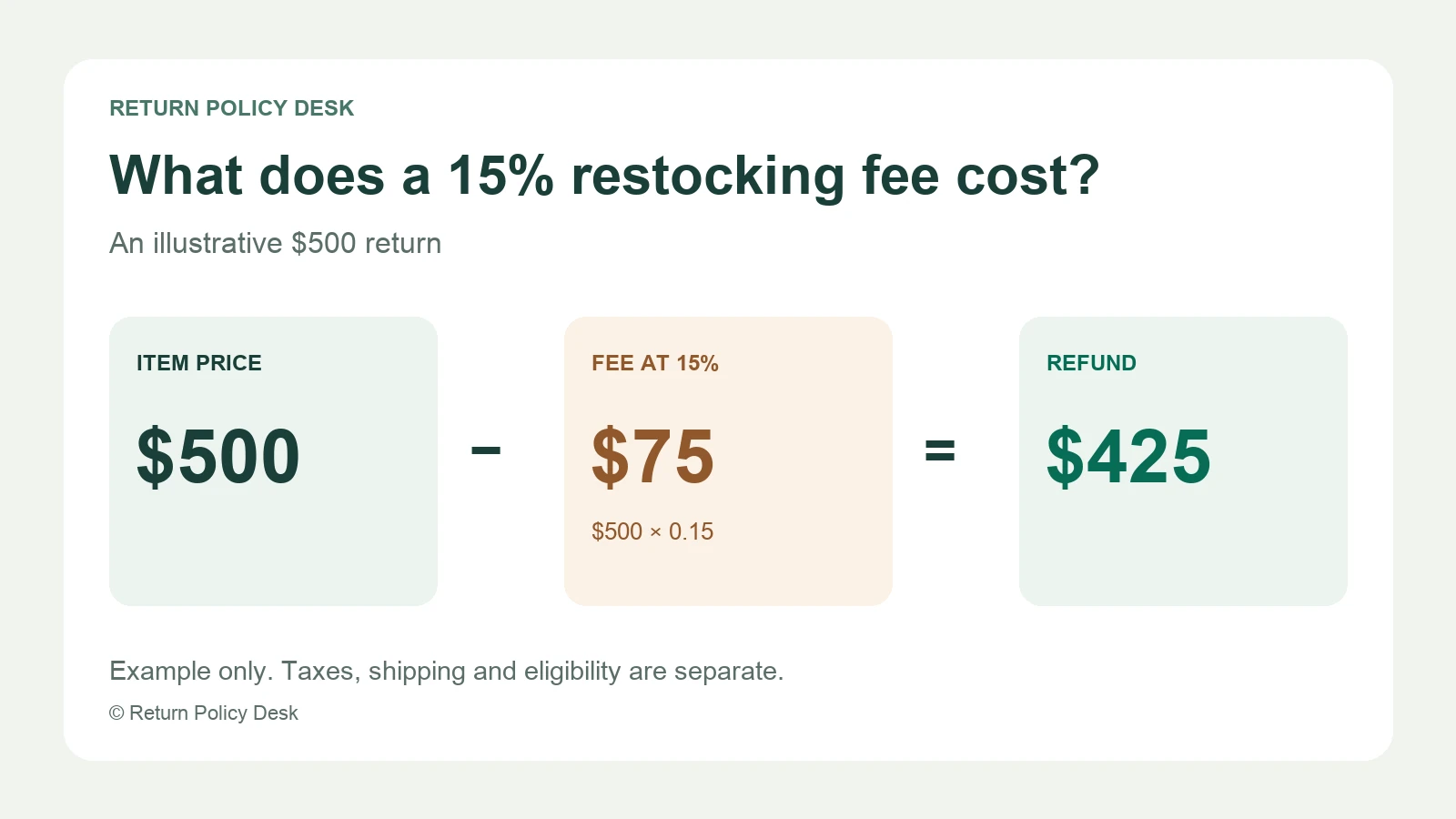
A restocking fee is a charge a retailer applies to certain returns, often deducted from your refund. It can be a fixed dollar amount or a percentage of the item’s purchase price. For example, a 15% fee on a $500 item is $75, leaving a $425 merchandise refund before any tax adjustments or other deductions.
Whether you owe one depends on the retailer, product, condition and reason for returning it. Some stores waive the fee for unopened merchandise. Others apply it to configured special orders or particular opened electronics. A prepaid shipping label does not tell you whether a restocking fee also applies.
Before sending something back, confirm three things: whether the item is returnable, which fee rule applies, and how much you will actually receive. This guide compares six U.S. retailers and explains how to check the calculation, preserve an available exemption and question an unexpected charge.
What a restocking fee pays for
Restocking means preparing returned merchandise to be offered for sale again. That can involve inspecting the item, checking its accessories and repackaging it. A seller may also need to offer an opened item at a lower price. A fee can offset those costs, but its name does not establish how much work was performed on your particular return.
For shoppers, the useful question is which published condition triggers the charge. Ask the retailer to identify the rule and explain how it applies to the transaction. A listed fee might cover one product category while a similar-looking item falls outside it.
The phrase also does not mean that every item is returnable for a price. A final-sale purchase can remain ineligible for a refund even if you offer to pay a restocking fee. Establish return eligibility before comparing deductions or planning the trip to a store.
How to calculate a restocking fee
For a percentage fee, multiply the applicable merchandise amount by the percentage expressed as a decimal. For a fixed fee, subtract the stated dollar amount. Confirm which amount the retailer uses, especially if you bought several items together or used a promotion.
| Illustrative merchandise amount | Fee | Fee amount | Merchandise refund after fee |
|---|---|---|---|
| $100 | 15% | $15 | $85 |
| $500 | 15% | $75 | $425 |
| $1,000 | 20% | $200 | $800 |
| $300 | Fixed $45 | $45 | $255 |
These are arithmetic examples, not approval of a return or a complete refund estimate. Sales tax, delivery charges, return postage and adjustments to discounts can affect the final amount. A fixed fee also costs a larger share of a cheaper purchase: $45 represents 15% of $300, but only 4.5% of $1,000.
Use the amount you actually paid for the affected item as your starting point, then compare it with the retailer’s calculation. If the deduction appears to include unrelated products, ask for an itemized explanation. Keep the original receipt and the proposed refund together so you can compare each line.
Restocking fees at six retailers
The amounts below apply only to the listed situations. They are not storewide charges on every return. On a phone, swipe the table sideways to read the conditions.
| Retailer | Published fee rule | Important qualification |
|---|---|---|
| Best Buy | $45 for activatable devices except prepaid phones; 15% for listed categories | Unopened products and purchases in specified states are exempt |
| Harbor Freight | Item-specific fee notice on the price tag, receipt or product page | Published waivers include unopened new merchandise and certain upgrades or replacements |
| Lowe’s | 20% on configured special orders returned or canceled after 72 hours from purchase | Return to the purchasing store; installation-contract qualifications apply |
| AT&T | Up to $55 when returning items to an AT&T-branded retail store | No fee for an Apple device returned in unopened packaging |
| Newegg | 15% for specified opened electronics categories | New unopened items and items received damaged or defective are exempt |
| Amazon | 100% for specified opened software, games and collectible categories | Damage, late-return and shipping fees are separate; check eligibility first |
Best Buy charges by product category
Best Buy’s 15% list includes drones, digital cameras and lenses, camcorders, projectors and screens, golf launch monitors, specified scooters, mobility products, recovery systems, premium cold tubs and saunas, and special-order products. Its fixed $45 fee applies to activatable devices, excluding prepaid phones.
The policy exempts unopened products and purchases made in Alabama, Colorado, Hawaii, Iowa, Mississippi, Ohio and Oklahoma, plus South Carolina and places where the charge is prohibited. The fee can be taxed in select states. Check the purchase location and exact item category before assuming the percentage applies. Best Buy’s official fee terms contain the complete list; our Best Buy return guide covers the broader return process.
Harbor Freight identifies affected items individually
Harbor Freight directs shoppers to the product page, shelf tag and receipt to identify a restocking fee. Its support page does not give one universal percentage, and the affected merchandise can change.
Its waivers cover unopened items in new condition, an upgrade within the same product category, a manufacturer-warranty replacement, or a replacement under an Extended Service Protection plan. A refund for an opened tool is not automatically the same as one of those replacements. Ask for the actual fee and any upgrade price difference before choosing a remedy. See the official restocking policy and our Harbor Freight return guide.
Lowe’s applies its rule to configured special orders
Lowe’s specifies a 20% fee when a configured special-order product is returned or canceled more than 72 hours after purchase. The item must go back to the purchasing store. The fee is taxed in select states, and installed sales can have qualifications in the installation contract or Right to Cancel.
For these orders, contact the store as soon as you discover a measurement or configuration problem. Do not assume the ordinary return window describes the cancellation terms. Read Lowe’s special-order fee rule alongside the order agreement. Our Lowe’s return guide explains its other categories.
AT&T names a store-return fee and an Apple exemption
AT&T’s consumer FAQ says a return to an AT&T-branded retail store may incur a fee of up to $55. An Apple device returned in unopened packaging is exempt. This wording should not be treated as a promise that every mailed return or every unopened brand receives the same exemption.
A device return and changes to wireless service are separate tasks. Confirm what happens to each before completing the transaction. Review AT&T’s official policy and our AT&T return guide for the purchase channel and device conditions.
Newegg distinguishes opened electronics from defects
Newegg’s current policy lists a 15% fee for opened hard drives, motherboards, graphics cards, projectors and televisions. New unopened returns are exempt, as are products received damaged or defective. It also directs shoppers to the product’s Warranty & Returns tab and any Marketplace seller terms.
Identify the category carefully. A rule naming graphics cards should not be assumed to cover every computer accessory. Check the item-specific return terms before opening it, then confirm any deduction when creating the return. Newegg’s official policy provides the conditions; our Newegg return guide explains the return routes.
Amazon separates several different return fees
Amazon’s customer policy lists a 100% restocking fee for software and video games that are opened, activated, used or missing parts, and specified opened collectible cards, board or tabletop games, and collectible or chase-variant figurines. Some products also have final-sale exclusions, so the fee table does not establish eligibility.
Amazon separately lists damage fees of up to 50% for qualifying condition problems not caused by Amazon or the seller, with a 100% rule for Amazon Luxury items. Shipping and late fees have their own conditions. Check the exact description of any deduction rather than calling every reduced refund a restocking fee. Read Amazon’s fee table and our Amazon return guide.
Three examples of how the fee changes a refund
The following situations are hypothetical. The prices illustrate the calculation; a retailer still has to approve the return and apply the rule to the actual purchase. Amounts below exclude tax adjustments, shipping and other charges.
An opened camera with a percentage fee
Suppose you paid $800 for a digital camera at Best Buy, opened it, and decided it did not suit you. If the return qualifies and the 15% fee applies to your purchase, the deduction is $120, leaving a $680 merchandise refund. An unopened camera or a purchase covered by a listed state exemption has different fee treatment under Best Buy’s policy.
Before comparing the camera with a cheaper alternative, include that $120 in the cost of switching. A $50 price saving elsewhere would not offset this illustrative deduction.
Canceling a configured special order after five days
Imagine a $1,000 configured special order at Lowe’s that you ask to cancel five days after buying it. Five days is beyond the published 72-hour threshold. If the order falls under the 20% rule and no applicable contract qualification changes it, the fee is $200, leaving $800 before other adjustments. Contact the purchasing store and check the order agreement under Lowe’s special-order terms.
This is a reason to review the configuration promptly. An item does not have to be opened for a special-order cancellation rule to matter.
A graphics card that is unwanted versus one received defective
Suppose a $600 graphics card from Newegg qualifies for a return. If you opened it and simply no longer want it, an applicable 15% fee would be $90, leaving $510 before other adjustments. If that same purchase was received defective, Newegg’s published exemption removes the restocking fee. The remedy and any separate charges still need confirmation.
Describe the actual problem when requesting the return. These scenarios show why the reason and arrival condition matter alongside the percentage; they do not make an otherwise ineligible return acceptable.
A restocking fee and return shipping are different charges
A restocking fee relates to the returned merchandise under the retailer’s rule. Return shipping pays for moving it back. Original delivery charges, pickup costs and condition-related deductions can create additional differences between the purchase total and the refund.
Ask for a breakdown showing the merchandise credit and each deduction separately. For an illustrative $500 item with a $75 restocking fee and a $10 return-label charge, the merchandise refund would be $415 before tax adjustments. If you paid postage directly to a carrier, that expense would reduce what you recover overall even though it might not appear on the retailer’s refund receipt.
When comparing store and mail returns, price the complete route. Include any postage, packaging supplies, pickup charge or travel cost. Returning in person may save shipping, but it should not be assumed to erase a product-based restocking fee. Confirm that the location can accept the item before traveling.
Can you avoid a restocking fee by keeping the item unopened
Sometimes. Preserve the seal until you understand the product’s rule. Best Buy, Harbor Freight and Newegg publish unopened-item exemptions with their respective conditions. AT&T names an exemption specifically for unopened Apple devices. The special-order rule at Lowe’s instead hinges on the order type and timing.
Check compatibility, dimensions, accessories and model information before opening an expensive purchase. For an item you already know is unsuitable, leaving it sealed can preserve an available exemption. Photograph the intact package if you plan to mail it back and keep the purchase record.
Opening the outer shipping carton is a different action from opening the manufacturer’s product packaging. Describe both accurately when contacting support. Do not reseal an opened product and present it as unopened; ask which rule applies to its actual condition.
What if the item arrived defective or damaged
Report the problem promptly and describe what happened. A product that arrived broken, one that failed during normal use, and one damaged after purchase may follow different return or warranty procedures.
Newegg expressly exempts items received damaged or defective from its restocking fee. Other retailers have their own replacement and warranty routes. Harbor Freight, for example, names qualifying warranty and protection-plan replacements in its fee waivers; that does not automatically describe every requested cash refund.
Before packing the item, photograph the fault, serial number, accessories and packaging. Save the delivery date and any support case number. Ask whether the approved remedy is a refund, replacement or repair, and request confirmation of any charge. Follow the authorized instructions, particularly for hazardous or bulky products, instead of arranging shipment independently.
Does an exchange or store credit remove the fee
There is no universal exemption just because you accept an exchange or store credit. Ask whether the retailer has a published waiver for the particular transaction.
For example, Harbor Freight names an upgrade within the same category as a waiver. That leaves a separate purchase decision: whether the more expensive product is one you actually want. Calculate the additional amount due before choosing an upgrade simply to avoid a deduction.
For any offered credit, check its value and where it can be used. A smaller cash refund and a larger store credit are different outcomes. Choose based on the amount and usefulness to you, after the associate confirms the fee treatment. Do not assume a change in refund method changes eligibility or resets the deadline.
How to question an unexpected restocking fee
Start with the facts of the transaction and ask for a review before accepting the proposed amount or sending the item away.
- Identify the charge. Ask whether it is a restocking fee, shipping cost, damage deduction or adjustment to a promotion.
- Request the applicable rule. Ask for the product category, amount or percentage, and any relevant condition.
- Explain the facts clearly. Give the purchase date, seller, return reason, packaging condition and any fault or delivery problem.
- Point to an applicable exemption. Show the policy provision that matches your return and ask how it was assessed.
- Get the calculation. Confirm which merchandise amount the percentage uses and whether tax or other deductions are included.
- Keep the response. Save the estimate, support messages, case number and final return receipt.
A specific request is easier to evaluate than a general demand to remove the fee. You might explain that the product remained factory sealed and ask the associate to review the unopened-item exemption. If the amount still appears inconsistent with the published terms, request a supervisor’s review and an itemized explanation.
Describe the return honestly. Changing the reason to “defective” when you simply no longer want the item can misstate the problem and send the return through an unsuitable process. A waiver request is also different from an existing exemption: ask for discretion when appropriate, without relying on a promised outcome.
Check the refund after the return is processed
Save the estimated refund before submitting the request, but keep the final return receipt as well. Compare the merchandise amount, each deduction and the refund method. If the final charge differs from the estimate, ask support what changed during processing.
For a mailed return, keep the authorization and carrier acceptance record until the refund is resolved. Package the correct item and its included components securely. A photograph of the packed contents can help explain what you sent if a question arises later.
Track the amount separately from its posting date. A bank delay does not explain an unexpected deduction, and a deduction dispute does not establish when the funds will post. Use the retailer’s refund instructions for timing while requesting a separate explanation of the charge.
Restocking fee checklist before buying or returning
For a purchase you may return, read the product’s own terms before relying on the store’s general headline. The most useful questions are:
- Is this exact item eligible for a return, and what starts the deadline?
- Does opening the product trigger a fee or make it nonreturnable?
- Is the fee fixed, percentage-based or identified only on the item’s notice?
- Which exemptions apply to the actual purchase and condition?
- Are return postage, pickup or original delivery charges separate?
- Does a special order have its own cancellation deadline and agreement?
- How much will be refunded, and where will the refund go?
Confirm the rule before opening the item and the amount before completing the return. Keep proof of purchase, use the approved return route and ask for a clear breakdown when the refund is reduced. Those steps give you a practical way to preserve a published exemption and avoid surprises without assuming every fee can be waived.
U.S. retailer policies checked October 10, 2026. Item-specific terms, purchase channel, condition and applicable exemptions determine the fee on an individual return.