


You open an Amazon return because something isn’t right. Instead of a label or a drop-off code, the instructions say the money is coming back and you don’t need to send the item anywhere.
It can feel like a mistake. You were ready to find a box; now you’re wondering whether you’re really allowed to keep what you bought.
Yes—when Amazon or the seller explicitly approves a refund without requiring a return, that’s a returnless refund. You receive the approved refund and keep the item as instructed. The reason is often straightforward: getting it back would cost more than it is worth to the business.
The important part is that explicit instruction. A refund appearing before you have sent the package does not, by itself, mean the return has been waived. Amazon also offers early refunds that still require the item to go back.
Here’s how to tell which situation you’re in, why some purchases qualify and what to do before you put the box away.
The quick check
Open the return details for the exact item. Look for a clear instruction that no return is required, and save it with the refund confirmation.
If the order still shows a return deadline, label or drop-off instructions and you haven’t been told they are waived, confirm the next step before putting the item away.
What is an Amazon returnless refund?
A returnless refund means Amazon or the seller refunds a purchase without asking you to ship that item back. Amazon also uses the term returnless resolution, which can describe a refund or, under some seller programs, a replacement while the buyer keeps the original product.
For the shopper, the practical benefit is simple: no return trip, postage or waiting for the unwanted item to reach a warehouse. But you still need an approved resolution for the purchase. An item being inexpensive, difficult to pack or inconvenient to return doesn’t mean a refund without a return is guaranteed.
The payment side still has to finish, too. The return requirement can be removed while the refund needs time to appear on your selected payment method. Keep the confirmation and check the amount and destination just as you would with an ordinary refund.
A real example: Amazon says the item can stay with you
In a February 19, 2024 customer-service email, Amazon’s Executive Relations team explicitly waived the return of a purchase. The customer could keep, donate or dispose of it.
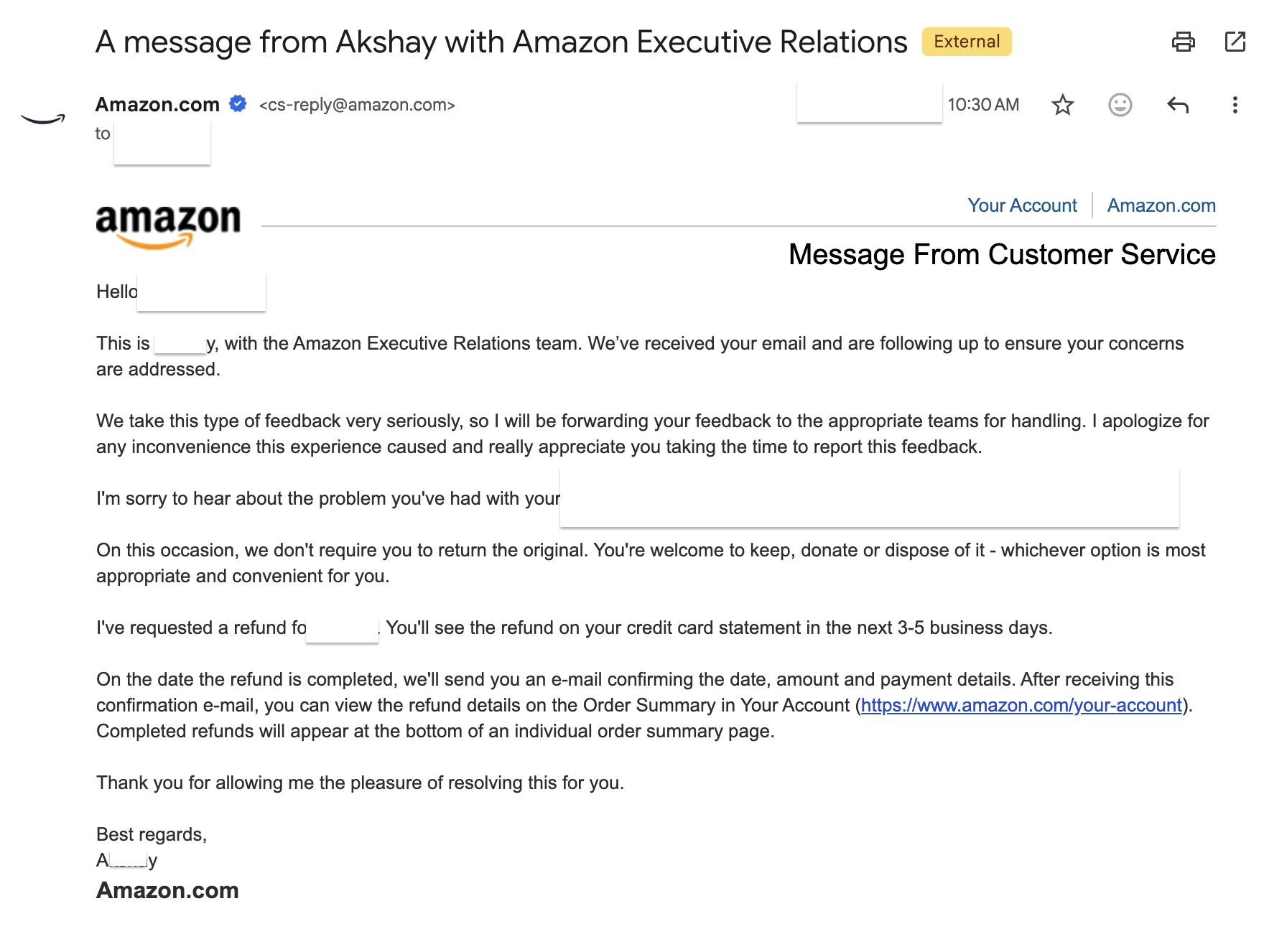
Open the redacted email screenshot at full size
That is the kind of clear instruction to look for. The email documents one customer-service resolution in 2024; check the instructions for your own purchase before deciding an item can stay with you. For a faulty or recalled product, follow the specific handling instructions rather than assuming it is suitable to use or donate.
Why would Amazon let you keep the item?
Because moving a product backward through the retail system can cost money at every stage.
There may be a collection or drop-off service, transport, inspection, sorting and a decision about whether the item can be sold again. For a low-value purchase, that work may cost more than the stock the seller would recover. A refund without a return can be the more sensible outcome.
Imagine a $9 household accessory that would cost $11 to transport and process. Those amounts are an illustration, not an Amazon price rule. Even before anyone considers reselling it, the economics are difficult. Asking the customer to send it back may achieve very little.
Amazon’s own seller guidance describes that cost comparison. Its FBA returnless program lets participating sellers choose settings for eligible inventory, and its announcements discuss avoiding shipping, inspection and other return costs. That explains why the option exists. It doesn’t establish what will happen to the next item in your account.
Why did one order qualify and another didn’t?
Because “bought on Amazon” covers more than one seller, fulfillment arrangement and product category.
One product may be sold and shipped by Amazon. Another may belong to a third-party seller but ship through Fulfillment by Amazon, or FBA. A third may be packed and shipped directly by the seller. Those purchases can reach you in similar-looking shopping journeys while following different return arrangements.
In Amazon’s FBA returnless program, the seller’s enrollment is only part of the decision. Amazon says each return is evaluated against item and customer eligibility criteria. Some returns from participating inventory still have to go back normally.
Seller-fulfilled orders have their own returnless arrangements, and sellers enroll in those separately from the FBA program. That is why a keep-the-item resolution for one purchase doesn’t establish a standing option for every purchase from the same account. Check the actual return offered for the item in front of you.
Is there a $75 limit for Amazon refunds without returns?
The current FBA Returnless Resolutions guidance lists an average selling price of $75 or less as one of that program’s per-item eligibility requirements. It also describes seller settings that can use a maximum item price between $1 and $75.
Those are rules for a particular seller program. There are other conditions, too. It is not a customer promise that every Amazon purchase under $75 qualifies. The rules also consider customer history, the seller’s standing and product exclusions. The seller must participate, and that particular return still has to qualify.
Average selling price also isn’t simply another name for the total on your receipt. A screenshot showing that someone paid less than $75 doesn’t prove all the conditions were satisfied for a different order.
The useful takeaway is to follow the resolution Amazon actually offers. Don’t build a purchase decision around a supposed guaranteed refund threshold, whether an online post calls it $25, $50 or $75. Different programs and situations cannot be reduced to one universal dollar rule.
Which items are excluded from that FBA program?
The current FBA returnless eligibility table excludes dangerous goods, recalled products, gift cards, heavy or bulky items and nonreturnable items. It also says eligibility is subject to legal, safety and regulatory guidelines.
That list matters because the simplest internet explanation—“it’s hard to ship, so they’ll let you keep it”—can lead you in the wrong direction. An expensive or difficult return is not automatically a candidate for this particular program.
It also helps explain why stories about different purchases can sound contradictory. A refund involving a nonreturnable product may be handled under a different product or customer-service policy. It does not prove that the item qualifies for FBA Returnless Resolutions.
As a shopper, you don’t need to identify every back-office program to resolve a problem. You need to report what happened accurately and get a clear answer about the remedy and whether anything must be sent back.
Nonreturnable doesn’t automatically mean “keep it and get a refund”
A product marked nonreturnable does not have an ordinary change-of-mind return just because another item once received a returnless refund.
Amazon’s customer policy lists categories that cannot be returned and separately identifies Final Sale merchandise as nonreturnable and nonrefundable. It tells shoppers to contact Customer Service if a nonreturnable or Final Sale item arrives damaged, defective or materially different from the order.
That is the distinction to work with. If the wrong item arrived, explain the mismatch. If it arrived damaged, describe the damage and keep photos. If you simply changed your mind about an excluded purchase, don’t assume the remedy will be the same.
You should also follow the instructions for the type of product involved. A message saying no return is required doesn’t tell you that a defective electrical item, recalled product or other potentially unsafe purchase is suitable to use or give away.
A returnless refund and an early refund are different
This is the part most likely to catch someone out.
Amazon describes an advanced refund as one issued when the carrier first scans the return, before Amazon receives and processes the item. Its help page also explains possible charges when a required return is not received within the applicable return window.
With a genuine returnless refund, the instruction is that you do not have to return the item. With an early or advanced refund, the refund has moved ahead of the completed return process.
| Situation | What it means for the item |
|---|---|
| Amazon or the seller explicitly says no return is required | Follow that approved returnless resolution |
| A refund arrives but the return instructions still apply | Complete the required return by its deadline |
| A replacement is coming and the original must be sent back | Follow the original-item return instructions |
| The messages conflict or the requirement is unclear | Ask for confirmation tied to the specific item |
For a fuller explanation of the timing, see Amazon refund issued but money not received. The issue date and the return obligation answer different questions.
How do you find out whether you can keep your order?
Start the ordinary return or problem-reporting process through your Amazon account. Choose the correct item and explain the real reason it didn’t work out. The options shown depend on that purchase.
Amazon’s FBA guidance says customers are not told in advance which items will receive a returnless resolution. If the eligibility criteria are met, the offer appears during the return process. There isn’t a shopper-facing list that guarantees a keep-the-item outcome before you buy.
If you receive that offer, read the final confirmation. Check the item, approved amount and any instructions about the product. Save the message or a screenshot in case another notification later seems inconsistent.
If the process produces a shipping label or drop-off code instead, follow that route unless Amazon or the seller confirms a different arrangement. Generating a label is not a step toward a guaranteed returnless outcome; it may simply mean the item needs to go back.
What if a seller tells you to keep it?
For a seller-fulfilled order, Amazon’s customer help lists a full refund without return as one of the return methods the seller can provide. The other listed routes are a U.S. return address or a prepaid label. The seller’s ability to offer a returnless refund does not mean you can insist on that choice for every order.
Keep the conversation in Amazon’s order messaging. Ask the seller to confirm that the item does not need to be returned and that the refund has been processed. Then check the refund details rather than treating a friendly “keep it” message as proof that payment has already been issued.
If Amazon’s automated return reminder conflicts with the seller’s instructions, ask for the mismatch to be resolved before the deadline. Save both messages and identify the order and item. A clear written instruction is more useful than trying to remember the wording from a phone call.
How long does a returnless refund take to reach you?
Removing the return shipment doesn’t remove payment processing.
After Amazon issues a refund, its published estimates include two to three hours for an Amazon gift-card refund, three to five business days for a credit card and up to ten business days for a debit card. Other methods have their own estimates. The refund details show where the approved money is being sent.
For example, if a returnless refund is issued to your credit card today, you shouldn’t assume the money will be visible in your banking app this afternoon. The item-return decision may be complete while the card posting is still underway.
If the stated period has passed, follow up with the issue date, amount and payment destination. Our Amazon refund-timing guide has the complete table and a short message you can use when the money can’t be located.
Can you donate, use or throw away the item?
First, confirm that no return is required. Keep the resolution message and any product-specific instructions before doing anything that would prevent a return if there is a misunderstanding.
Then consider the reason for the refund. An unwanted but sound household item is a different situation from one with an electrical fault, contamination concern or recall. A refund approval does not certify that a product is safe. Follow any disposal, recall or other handling instructions you receive.
Once the returnless resolution is clear, you don’t need to keep an ordinary shipping box indefinitely just because there was a refund. The important records are the instruction saying no return is required and the payment confirmation. If you plan to donate the product, make sure its condition is suitable rather than passing an unresolved defect to somebody else.
What if you already dropped the item off?
If you completed a required return and then received a refund notification, that may simply be the normal process working. It is not evidence that you were supposed to keep the item.
Keep the acceptance receipt and follow the tracking and refund details. If a separate message explicitly says no return was required after you have already handed the parcel over, contact Amazon or the seller to clarify the record. Don’t make a second claim that the same item is still in your possession if it has already been sent back.
This is another reason to match the exact product and quantity. A multi-item order can produce more than one return decision. Permission to keep one inexpensive accessory doesn’t necessarily apply to another item from the same checkout.
Is it wrong to accept a returnless refund?
An authorized returnless refund is an option Amazon or the seller has chosen to offer. You can accept it and follow its instructions. You don’t need to insist on shipping a product that the approved resolution says should stay with you.
Be accurate about the problem and keep the confirmation. Amazon’s FBA guidance says refund requests are monitored and returnless resolutions are not unconditionally approved. It also says a returnless resolution is still tracked as a customer return. The absence of a parcel does not make it an invisible transaction.
There is no need to turn the process into a strategy for getting free purchases. If the item is fine and you want to keep it, a refund request based on an invented defect isn’t an ordinary use of the policy. Report what actually happened and use the remedy offered for that purchase.
The question to ask if you’re still unsure
Before you use the item, donate it or ignore a deadline, ask:
Please confirm whether this specific item must be returned. I have a refund notification, but I want to make sure there is no outstanding return requirement or deadline.
That settles the question that matters. You don’t need to guess which program handled the transaction or whether someone else received the same offer.
If the answer is that no return is required, keep the confirmation and check that the approved refund reaches the stated destination. If the item must go back, follow the supplied route and deadline. For the broader windows and product exceptions, see our Amazon return-policy guide.